STAR Method Explained – How to Answer Behavioral Interview Questions
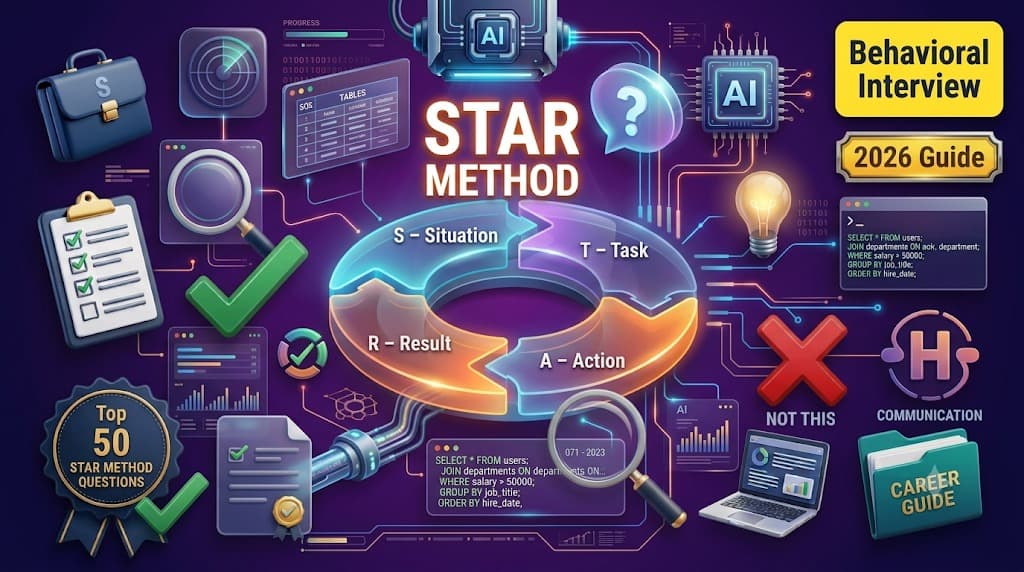
“Tell me about a time you faced a challenge.” “Describe a situation where you had to meet a tight deadline.” These questions sound easy until you're actually in the interview seat. Without a structure, most people either ramble or go blank. The STAR method fixes that completely.
What is the STAR Method?
STAR is an acronym for four components of a complete behavioral answer:
- S — Situation: The context or background of the story
- T — Task: Your specific responsibility in that situation
- A — Action: The concrete steps you personally took
- R — Result: The outcome of your actions, ideally quantified
When to Use the STAR Method
Use STAR whenever you hear interview questions that begin with:
- “Tell me about a time when...”
- “Give me an example of...”
- “Describe a situation where...”
- “Have you ever had to...”
- “How have you handled...”
Breaking Down Each Component
S — Situation
Briefly describe the context. Keep this short — 1–2 sentences. The interviewer needs just enough background to understand the story.
T — Task
Explain your specific role or responsibility in that situation. What were you expected to do? What was the challenge you faced?
A — Action
This is the most important part. Describe the specific steps you took. Use “I”, not “we” — interviewers want to know what you personally did. This section should be the longest part of your answer.
R — Result
Share the outcome. Quantify it where possible — numbers, percentages, or specific improvements make the result much more compelling. Also mention any learning or takeaway if relevant.
STAR Example Answer – Teamwork Question
Q: Tell me about a time you worked effectively in a team.
S: “In my final year, my team of four had to build a full-stack web application in 8 weeks for our capstone project.”
T: “I was responsible for the backend API development and also coordinating between the frontend and database teams.”
A: “I created clear API documentation using Swagger so the frontend team could work independently. I held brief daily check-ins to identify blockers early and proactively resolved two integration issues before they caused delays.”
R: “We delivered the project three days ahead of the deadline and received the highest grade in our batch. More importantly, I learned how documentation and proactive communication can make or break a team project.”
STAR Example Answer – Problem Solving Question
Q: Describe a time you solved a difficult technical problem.
S: “During a client demo preparation, our deployment pipeline kept failing 45 minutes before the scheduled presentation.”
T: “As the lead developer on the project, it was my responsibility to diagnose and fix the issue before the demo.”
A: “I immediately analyzed the CI/CD error logs, identified a missing environment variable in the production configuration, fixed it, and added a pre-deployment validation check to prevent similar issues.”
R: “The demo ran successfully. The validation check I added became a permanent part of our pipeline and prevented two similar failures in the following months.”
Tips for Strong STAR Answers
- Prepare at least 5–6 STAR stories before your interview, covering different themes: teamwork, leadership, failure, conflict, problem-solving
- Keep the Situation and Task brief — most of your answer should be Action and Result
- Always use “I” in the Action section — focus on your contribution
- Quantify results wherever possible — numbers make answers far more credible
- Practice delivering your STAR stories out loud, not just in writing
Common STAR Mistakes
- Making the Situation too long — interviewers want to hear what you did, not just the backstory
- Saying “we did this” throughout without clarifying your personal role
- Forgetting the Result — an answer without an outcome feels incomplete
- Using vague results like “it went well” instead of specific outcomes
Final Thoughts
The STAR method turns open-ended behavioral questions into structured, compelling stories. With practice, it becomes a natural way to communicate your experience and impact. Practice your STAR answers with AI-powered mock interviews at Roundexa.com to get real feedback on your delivery and structure before facing real recruiters.
Ready to Practice?
Take a free AI mock interview on Roundexa and get instant, actionable feedback before the real one.
Practice on RoundexaRead Next
Top 25 HR Interview Questions and Answers for Freshers
25 of the most common HR interview questions — with real, natural-sounding answers you can actually use. No copy-paste scripts, just guidance on what to say and why it works.
Tell Me About Yourself – Best Answers for Freshers and Experienced Professionals
You've been asked this question in every interview — and most people still don't answer it well. Here's a simple framework that makes your answer clear, confident, and memorable every time.